Jewelry in ten minutes.Enough for your first client.
Metals, settings, diamonds and colored stones: what clients care about. You don’t necessarily need a background in the trade. The rest comes with your onboarding.
Free, about ten minutes, right here on this page. Just scroll: no sign-up, no call.
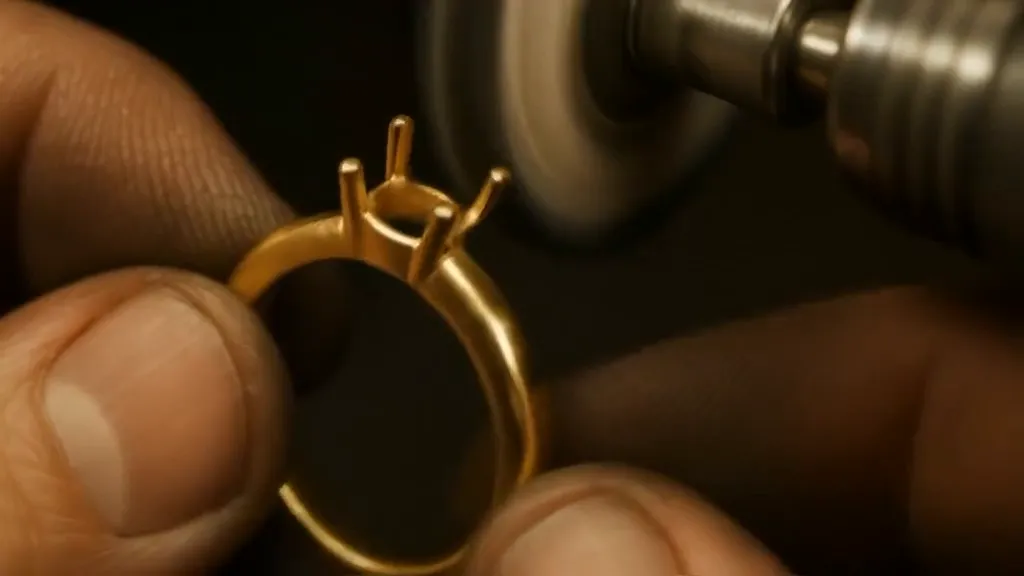
Enough for a first conversation with a client. Not more.
- Metals and settings. What a piece is made of, and how the stone is held.
- Diamonds. The four Cs, shapes, sizes and the certificate.
- Colored stones. The big three, what drives value, and hardness.
Sourcing and manufacturing. savro takes care of those. What matters is knowing what a client is asking for, and what to ask back.
Metals and settings
What the piece is made of, and how the stone is held. Clients ask about both before they ask about the stone.
Gold is measured in karats. 18K and 14K are the ones you’ll meet.
The number is the share of pure gold in the alloy. More gold means a richer color and a softer metal. The rest of the alloy gives the gold its color and lets it hold a stone.
Yellow gold
Gold with silver and copper. The classic.
White gold
Gold with palladium or nickel, usually rhodium-plated. Needs re-plating every few years.
Rose gold
Gold with more copper. Warm and modern.
Platinum
Naturally white, dense and hypoallergenic. Doesn’t tarnish. The premium choice.
Sterling silver (92.5%) is for fashion jewelry. It tarnishes.
How the stone is held changes how it looks and how it wears.
Six settings cover nearly everything. Prong and bezel are the two to know well: most conversations about a ring come down to one or the other.
Prong
Four or six metal claws grip the stone at its edge, so almost all of it is open to the light. The classic solitaire.
Bezel
A rim of metal runs all the way around the stone and folds over its edge. Nothing catches, and it’s very secure. Good for hands that work.
Pavé
Small stones set edge to edge, held by tiny beads of metal. The band reads as a surface of sparkle.
Channel
Square stones sit flush in a groove between two metal rails, with no metal between them. Sleek; wedding and eternity bands.
Halo
A ring of small stones around the center stone. The whole head looks larger and brighter than the center stone alone.
Tension
The band is sprung open and holds the stone by pressure alone. A floating look that needs precise engineering.
Diamonds
Four Cs, eight shapes, one certificate. Cut matters most, but clients ask about carat.
The four Cs, and why cut comes first.
Cut most important
How the facets return light. A flawless, colorless stone looks dull if it is cut badly. Ask for Excellent or Very Good.
Color
D (colorless) to Z (light yellow). The less color, the rarer and more expensive.
Clarity
Inclusions and blemishes under 10× magnification, from Flawless to Included.
Carat
Weight, not size. One carat is 0.2 grams. The price climbs faster than the weight.
GIA cut grades: Excellent · Very Good · Good · Fair · Poor. Good still looks fine to the naked eye; Fair and Poor don’t.
Color and clarity: where the smart value sits.
D–F colorless
The rarest. Differences only a grader can see.
G–J near colorless
Any warmth disappears once the stone is set. The best-selling range.
K–M faint
Slight warmth, lovely in yellow gold.
SI1 eye-clean
Nothing visible without a loupe. Often the smart buy; VS is the safe one.
Carat is weight. What the client sees is millimeters.
Round brilliants seen from above, at relative size.
Price isn’t linear
Two half-carat stones cost far less than one one-carat stone. Rarity climbs faster than weight.
The magic weights
0.50, 1.00, 1.50 and 2.00 ct carry a premium. A 0.90 ct stone looks almost the same as a 1.00 ct and costs noticeably less.
Spread over weight
A well-cut stone, or an elongated shape, looks bigger than its weight suggests. That’s the craft.
Eight shapes cover almost everything clients ask for.
Round is the default and the most expensive per carat. Everything else is called a fancy shape. Elongated shapes look larger for their weight.
Round brilliant
Three in four diamonds sold. 58 facets, maximum sparkle.
Oval
Elongated, flattering on the finger, and looks larger for its weight. Very brilliant.
Cushion
Softly rounded corners and large facets. Vintage charm, beautiful fire.
Emerald
A step cut with long, clean lines. Art Deco. Shows inclusions, so clarity matters more.
Pear
Round at one end, pointed at the other. Unusual and elongating.
Marquise
Pointed at both ends, with the most face-up size per carat. Slims the finger.
Princess
Square with sharp corners and brilliant faceting. Modern; the second most popular shape.
Radiant
The emerald outline with brilliant faceting. Versatile and very lively.
Every savro diamond over 0.30 ct comes with a grading report. GIA is the standard.
The Gemological Institute of America is the grading authority the trade trusts. Its report makes a stone comparable, insurable and resellable, and it protects you as much as your client. Some stones are graded by HRD or IGI instead, two other recognized labs; the quote always shows which report comes with the stone.
- Report number, verifiable at gia.edu
- Shape, cut grade, color, clarity, carat
- Polish, symmetry, fluorescence
- Proportions diagram and inclusion plot
Colored stones
There’s no universal grading, so the eye decides. Color first, everything else after.
The big three
Ruby
Red corundum. The finest reds fetch more per carat than any other colored stone. Burma is the name to know.
Sapphire
Corundum in blue, and in pink, yellow and green. Kashmir and Burma are the most prized origins.
Emerald
Green beryl. Inclusions, called jardin, are normal and expected. Colombia is the top tier.
Then tanzanite, tourmaline, aquamarine, spinel, garnet and amethyst: a color for every taste and budget.

What actually sets the price
Color
Hue, tone and saturation. Vivid, medium-toned stones win. This is most of the price.
Clarity
Eye-clean is the goal, not flawless. Inclusions are normal.
Cut
Cut to bring out the color. Symmetry matters less than with diamonds.
Origin
Kashmir, Colombia and Burma command a premium. Fine stones come with a lab report on their origin.
- Heat: sapphires and rubies. Near-universal, permanent and accepted.
- Oiling: emeralds. Traditional, and may need refreshing over the years.
- Diffusion, glass filling: lowers the value a lot. Always disclosed; best avoided.
Which stones can live on a hand.
Hardness on the Mohs scale, where 10 is diamond. It decides which stones belong in a ring and which are happier in earrings and pendants.
Rings want 8 and up. Below that: a protective setting, or earrings and pendants.
The crash course as a PDF.
Free, to read later or print. We’ll email it to you.
It’s on its way. Check your inbox in a minute. Please also confirm the news sign-up with the link in that email.
When you’re ready, book an intro call.
The rest you learn with us.
Stones, metals and settings are part of your onboarding, and your savro contact is there on every project.
savro.co · Questions, or ready to start? Book an intro call at savro.co
Not ready for a call? Ask us a question first